
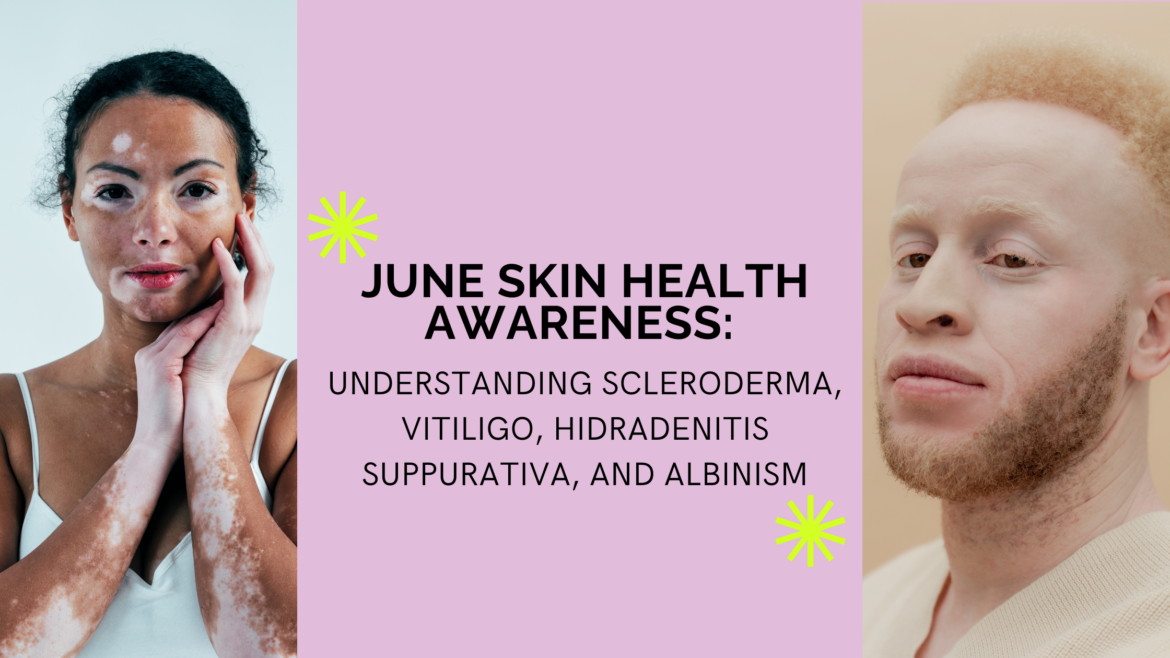
June is a month rich in important dermatological awareness initiatives, each spotlighting conditions that profoundly impact patients’ lives yet remain widely misunderstood by the general public. As a board-certified dermatologist, I believe that education is the foundation of effective care. This month, we focus on four distinct conditions: scleroderma, vitiligo, hidradenitis suppurativa, and albinism, each representing unique challenges that require specialized dermatological expertise, compassionate care, and ongoing research.
Scleroderma Awareness Month: Understanding a Complex Autoimmune Disease
Scleroderma, derived from the Greek words for “hard skin,” is a chronic autoimmune disease characterized by the hardening and tightening of the skin and connective tissues. According to the Scleroderma Foundation, approximately 300,000 Americans are affected by this condition, with women being four times more likely to develop it than men¹.
Types of Scleroderma
Scleroderma manifests in two primary forms, each with distinct characteristics and implications:
Localized Scleroderma: Affects primarily the skin, with minimal involvement of internal organs. This form includes morphea, which causes oval-shaped hardened patches on the skin, and linear scleroderma, which creates bands of hardened skin along the arms, legs, or face.
Systemic Sclerosis: A more serious form that affects not only the skin but also internal organs, including the lungs, heart, kidneys, and digestive tract. Systemic sclerosis is further divided into:
- Limited cutaneous systemic sclerosis: Skin hardening confined to the hands, arms, and face
- Diffuse cutaneous systemic sclerosis: More widespread skin involvement with a higher risk of internal organ complications
The Science Behind Scleroderma
Research published in the Journal of the American Academy of Dermatology demonstrates that scleroderma involves three key pathological processes: immune system activation, vascular damage, and excessive fibrosis (scarring)². The immune system mistakenly attacks healthy tissue, triggering inflammation and stimulating fibroblasts to produce excessive collagen, leading to the characteristic skin hardening.
Early Warning Signs:
- Raynaud’s phenomenon (fingers turning white or blue in response to cold)
- Puffy or swollen fingers and hands
- Skin thickening or tightening
- Joint pain and stiffness
- Digestive issues
- Fatigue
Dermatological Management of Scleroderma
While there is no cure for scleroderma, dermatological management focuses on:
- Moisturizing and protecting hardened skin
- Managing Raynaud’s phenomenon
- Treating skin ulcers and wounds
- Monitoring for skin cancer risk
- Coordinating care with rheumatologists and other specialists
The American Academy of Dermatology emphasizes the importance of early diagnosis and multidisciplinary care in effectively managing scleroderma³. Regular dermatological monitoring can help detect complications early and improve quality of life.
Vitiligo Awareness Month: Embracing Skin Diversity
Vitiligo is a chronic autoimmune condition that causes loss of skin pigmentation, resulting in white patches on the skin. The World Health Organization estimates that vitiligo affects 0.5-2% of the global population, impacting approximately 70 million people worldwide⁴. Despite its prevalence, vitiligo remains surrounded by misconceptions and stigma that can profoundly affect patients’ psychological well-being.
Understanding Vitiligo’s Mechanisms
Vitiligo occurs when melanocytes, the cells responsible for producing skin pigment (melanin), are destroyed by the immune system. Research published in the New England Journal of Medicine has identified specific immune pathways involved in melanocyte destruction, particularly the JAK-STAT signaling pathway, which has become an important therapeutic target⁵.
Types of Vitiligo:
Non-Segmental Vitiligo: The most common form, characterized by symmetrical white patches on both sides of the body. This type tends to be progressive and is associated with other autoimmune conditions.
Segmental Vitiligo: Affects only one side or segment of the body. This form tends to be more stable and less likely to spread.
Universal Vitiligo: A rare form involving depigmentation of most of the body surface.
Impact on Diverse Skin Types
Vitiligo affects people of all skin types and ethnicities, but its visibility and psychological impact can be particularly significant in individuals with darker skin tones, where the contrast between affected and unaffected skin is more pronounced. The Skin of Color Society emphasizes the need for culturally sensitive care and specialized treatment approaches for patients with skin of color⁶.
Treatment Advances
Recent years have seen significant advances in vitiligo treatment:
Topical Treatments:
- Topical corticosteroids for localized disease
- Calcineurin inhibitors (tacrolimus, pimecrolimus)
- Topical JAK inhibitors
Phototherapy:
- Narrowband UVB phototherapy remains a cornerstone of treatment
- Excimer laser for localized patches
Systemic Treatments:
- Oral JAK inhibitors are showing promising results in clinical trials
- The FDA approval of ruxolitinib cream (Opzelura) in 2022 marked a significant milestone as the first FDA-approved treatment specifically for vitiligo⁷
Surgical Options:
- Melanocyte transplantation for stable vitiligo
- Skin grafting for localized disease
The Psychological Dimension
Research consistently demonstrates that vitiligo has a profound psychological impact, with studies showing increased rates of depression, anxiety, and reduced quality of life among affected individuals⁸. A comprehensive approach to vitiligo care must address both the physical and emotional aspects of the condition.
Hidradenitis Suppurativa Awareness Week (June 1-7): Shedding Light on a Painful Condition
Hidradenitis suppurativa (HS) is a chronic inflammatory skin disease that causes painful nodules, abscesses, and scarring in areas where skin rubs together, such as the armpits, groin, buttocks, and under the breasts. Despite affecting approximately 1-4% of the population, HS remains one of the most underdiagnosed and undertreated dermatological conditions⁹.
Understanding HS Pathophysiology
HS develops when hair follicles become blocked and rupture, triggering an intense inflammatory response. The condition is not caused by poor hygiene, as is commonly and incorrectly believed. Research published in the Journal of Investigative Dermatology demonstrates that HS is characterized by dysregulation of the innate immune system, with elevated levels of inflammatory cytokines, including TNF-alpha and IL-17¹⁰.
Risk Factors:
- Genetic predisposition (family history in approximately 40% of cases)
- Hormonal influences (more common in women)
- Obesity and metabolic syndrome
- Smoking
- Certain medications
The Diagnostic Challenge
One of the most significant challenges in HS management is delayed diagnosis. Studies show that patients wait an average of 7-10 years from symptom onset to receiving a correct diagnosis¹¹. This delay leads to disease progression, increased scarring, and significant psychological burden.
Hurley Staging System:
HS is classified using the Hurley staging system:
- Stage I: Single or multiple abscesses without scarring or sinus tracts
- Stage II: Recurrent abscesses with sinus tract formation and scarring
- Stage III: Diffuse involvement with multiple interconnected sinus tracts and abscesses
Treatment Approaches
Medical Management:
- Topical antibiotics (clindamycin) for mild disease
- Oral antibiotics (tetracyclines, combination therapy)
- Hormonal therapies for women
- Biologic medications (adalimumab is FDA-approved for moderate-to-severe HS)
- JAK inhibitors showing promise in clinical trials
Procedural Interventions:
- Intralesional corticosteroid injections for acute flares
- Laser therapy for hair follicle destruction
- Surgical excision for severe, refractory disease
Lifestyle Modifications:
- Weight management
- Smoking cessation
- Gentle skincare practices
- Avoiding tight clothing
The Burden of HS
Research consistently demonstrates that HS has one of the highest impacts on quality of life among dermatological conditions. Studies show that HS patients experience higher rates of depression, anxiety, and social isolation compared to patients with other chronic skin conditions¹². The painful, malodorous nature of the condition can significantly impact relationships, employment, and daily activities.
International Albinism Awareness Day (June 13): Celebrating Diversity and Promoting Understanding
Albinism is a rare, genetically inherited condition characterized by reduced or absent melanin production, resulting in lighter skin, hair, and eyes. The National Organization for Albinism and Hypopigmentation estimates that albinism affects approximately 1 in 17,000 people in the United States, though prevalence varies significantly by geographic region and ethnic background¹³.
The Genetics of Albinism
Albinism results from mutations in genes involved in melanin production. The most common forms include:
Oculocutaneous Albinism (OCA): Affects the skin, hair, and eyes. Multiple subtypes exist, each caused by mutations in different genes involved in melanin synthesis.
Ocular Albinism: Primarily affects the eyes, with minimal impact on skin and hair pigmentation.
Hermansky-Pudlak Syndrome: A rare form of albinism associated with bleeding disorders and lung disease.
Dermatological Considerations
From a dermatological perspective, individuals with albinism face unique challenges:
Sun Sensitivity: The absence of melanin, which normally provides some protection against UV radiation, makes individuals with albinism extremely susceptible to sunburn and sun damage. The American Academy of Dermatology emphasizes that individuals with albinism have a significantly elevated risk of developing skin cancer, including melanoma¹⁴.
Skin Cancer Surveillance: Regular dermatological monitoring is essential for individuals with albinism. Studies show that skin cancer develops at younger ages and with higher frequency in this population, making early detection and prevention critical¹⁵.
Comprehensive Sun Protection:
- Daily application of broad-spectrum SPF 50+ sunscreen
- Protective clothing with high UPF ratings
- Wide-brimmed hats and UV-blocking sunglasses
- Seeking shade during peak UV hours
- Regular professional skin examinations
Global Perspectives on Albinism
In many parts of the world, particularly in sub-Saharan Africa, individuals with albinism face significant discrimination, violence, and social exclusion based on harmful myths and misconceptions. International Albinism Awareness Day serves as an important reminder of the need for education, advocacy, and protection of the rights of individuals with albinism globally.
The Importance of Inclusive Dermatological Care
The conditions highlighted this June share a common thread: they all require specialized, culturally sensitive dermatological care that recognizes the unique needs of diverse patient populations. As dermatologists, we have a responsibility to:
Provide Culturally Competent Care:
Understanding how these conditions present differently across skin types and ethnicities is essential for accurate diagnosis and effective treatment. Conditions like vitiligo and HS may present differently in patients with skin of color, requiring specialized knowledge and experience.
Address Psychological Impact:
All four conditions discussed this month can have profound psychological effects. A comprehensive approach to care must include attention to mental health, with appropriate referrals for psychological support when needed.
Advocate for Research and Awareness:
Continued research into these conditions is essential for developing better treatments and improving patient outcomes. Patient advocacy organizations play a crucial role in funding research and raising awareness.
Conclusion: Education, Empathy, and Expert Care
June’s awareness initiatives remind us that dermatology encompasses far more than cosmetic concerns. Conditions like scleroderma, vitiligo, hidradenitis suppurativa, and albinism represent complex medical challenges that require expert diagnosis, personalized treatment, and compassionate care.
At Hair and Skin Science Center, we are committed to providing comprehensive dermatological care for all skin types and conditions. Whether you’re seeking diagnosis and treatment for a complex autoimmune condition or looking for guidance on managing a chronic skin disease, our team is here to provide evidence-based, patient-centered care that addresses both the physical and emotional aspects of your condition.
If you or a loved one is affected by any of the conditions discussed in this blog, we encourage you to seek professional dermatological evaluation. Early diagnosis and appropriate treatment can significantly improve outcomes and quality of life.
Sources:
- Scleroderma Foundation. “What is Scleroderma?” Available at: https://www.scleroderma.org/site/SPageServer/?pagename=patients_whatis
- Varga, J., & Abraham, D. “Systemic sclerosis: a prototypic multisystem fibrotic disorder.” Journal of Clinical Investigation, 2007.
- American Academy of Dermatology. “Scleroderma: Overview.” Available at: https://www.aad.org/public/diseases/a-z/scleroderma-overview
- World Health Organization. “Vitiligo.” Available at: https://www.who.int/news-room/fact-sheets/detail/vitiligo
- Harris, J. E., et al. “A mouse model of vitiligo with focused epidermal depigmentation requires IFN-γ for autoreactive CD8+ T-cell accumulation in the skin.” Journal of Investigative Dermatology, 2012.
- Skin of Color Society. “Vitiligo in Skin of Color.” Available at: https://skinofcolorsociety.org
- U.S. Food and Drug Administration. “FDA Approves First Treatment for Nonsegmental Vitiligo.” 2022.
- Linthorst Homan, M. W., et al. “The burden of vitiligo: patient characteristics associated with quality of life.” Journal of the American Academy of Dermatology, 2009.
- Jemec, G. B. “Hidradenitis suppurativa.” New England Journal of Medicine, 2012.
- Schlapbach, C., et al. “Expression of the IL-23/Th17 pathway in lesions of hidradenitis suppurativa.” Journal of the American Academy of Dermatology, 2011.
- Saunte, D. M., & Jemec, G. B. “Hidradenitis suppurativa: advances in diagnosis and treatment.” JAMA, 2017.
- Matusiak, L., et al. “Psychophysical aspects of hidradenitis suppurativa.” Acta Dermato-Venereologica, 2010.
- National Organization for Albinism and Hypopigmentation. “About Albinism.” Available at: https://www.albinism.org/information-bulletin-what-is-albinism/
- American Academy of Dermatology. “Albinism and skin cancer risk.” Available at: https://www.aad.org
- Lookingbill, D. P., et al. “Skin cancer in black and white patients.” Journal of the American Academy of Dermatology, 1993.