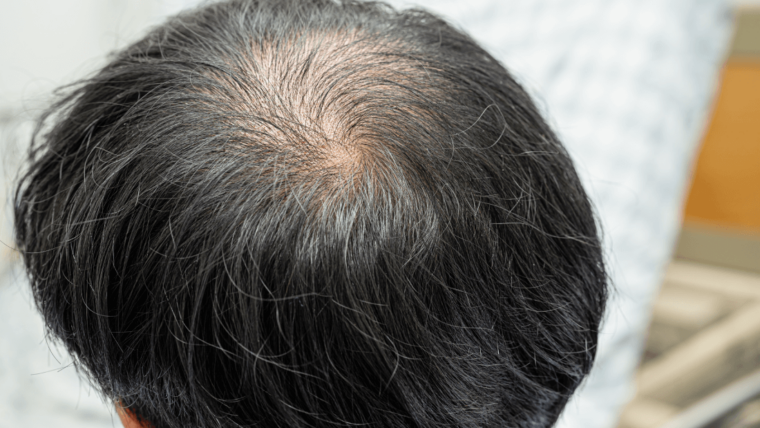

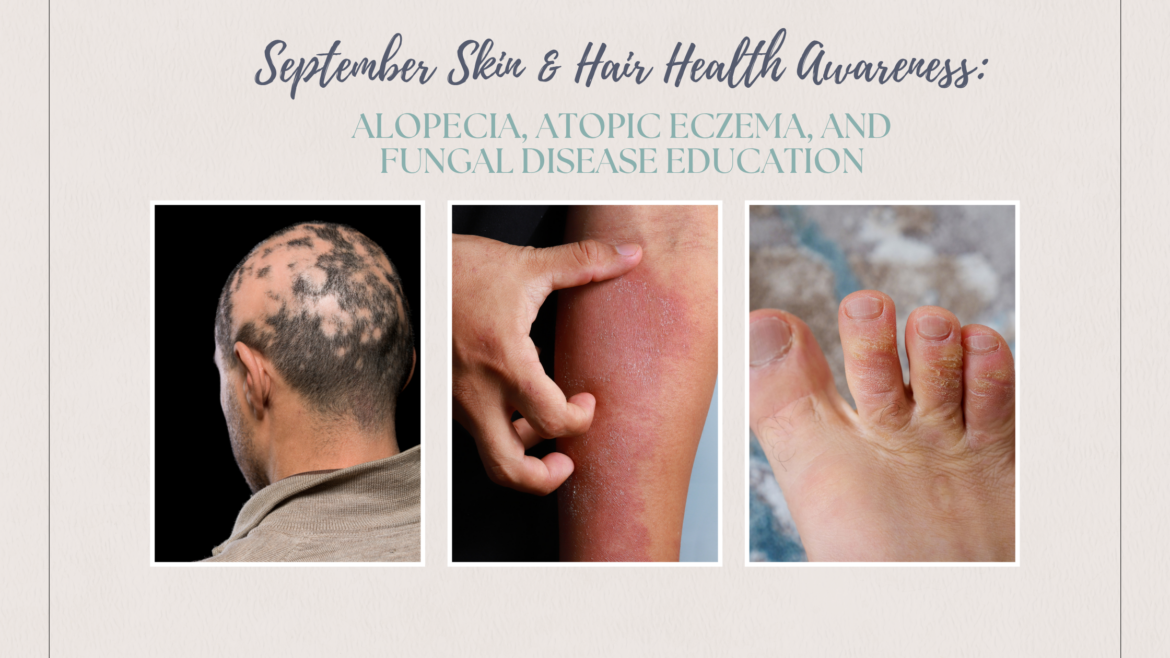
September brings together several important health awareness initiatives that highlight the diverse challenges patients face with hair and skin conditions. As a board-certified dermatologist, I recognize that education is often the first step toward effective treatment and improved quality of life. This month, we focus on Alopecia Awareness Month, World Atopic Eczema Day, and Fungal Disease Awareness Week—three distinct areas of dermatology that, despite their differences, share a common need for accurate diagnosis, evidence-based treatment, and patient support.
Alopecia Awareness Month: Understanding Hair Loss Conditions
September marks Alopecia Awareness Month, dedicated to educating the public about alopecia areata and other forms of hair loss that affect millions of people worldwide. The National Alopecia Areata Foundation estimates that approximately 6.8 million Americans experience alopecia areata alone, with a lifetime risk of about 2% for the general population¹.
Understanding Alopecia Areata
Alopecia areata is an autoimmune condition in which the immune system mistakenly attacks hair follicles, resulting in sudden, often patchy hair loss. Unlike androgenetic alopecia, which is genetically driven and gradual, alopecia areata can appear suddenly and affects individuals of all ages, though it often develops before age 30².
Recognizing the Signs:
- Round or oval patches of hair loss on the scalp or body
- Hair loss that can progress to alopecia totalis (complete scalp hair loss)
- In severe cases, alopecia universalis (complete body hair loss)
- Nail changes including pitting or ridging in some patients
Treatment Advances:
The treatment landscape for alopecia areata has evolved significantly in recent years. Traditional treatments including topical and intralesional corticosteroids remain first-line options for localized disease. However, the FDA approval of JAK inhibitors, including baricitinib in 2022, has revolutionized treatment for more severe and extensive cases, offering renewed hope for patients who previously had limited options³.
The Emotional Impact of Hair Loss
Beyond the physical symptoms, alopecia carries a significant psychological burden. Research consistently demonstrates that hair loss conditions are associated with increased rates of anxiety, depression, and reduced quality of life⁴. This September, we encourage anyone affected by hair loss to seek both medical treatment and, when needed, emotional support through counseling or patient advocacy organizations like the National Alopecia Areata Foundation.
World Atopic Eczema Day: September 14th
World Atopic Eczema Day, observed annually on September 14th, brings global attention to atopic dermatitis, a chronic inflammatory skin condition affecting over 31 million Americans⁵. This day serves as an important reminder that eczema is far more than dry skin—it’s a complex condition with significant physical and emotional impacts.
The Science of Atopic Eczema
Atopic dermatitis results from a combination of genetic predisposition, immune system dysfunction, and environmental triggers. Research shows that mutations in the filaggrin gene, which helps maintain the skin barrier, are present in approximately 20-30% of patients with eczema, contributing to increased water loss and susceptibility to irritants and allergens⁶.
Common Triggers:
- Harsh soaps, detergents, and fragranced products
- Environmental allergens including dust mites and pet dander
- Temperature and humidity changes
- Stress and emotional factors
- Certain fabrics, particularly wool and synthetic materials
Evidence-Based Management:
Effective eczema management requires a comprehensive approach:
- Consistent moisturizing with fragrance-free, barrier-repairing products
- Gentle cleansing practices using lukewarm water
- Identification and avoidance of personal triggers
- Topical anti-inflammatory treatments including corticosteroids and calcineurin inhibitors
- Newer biologic therapies for moderate-to-severe cases
Beyond the Skin: The Hidden Impact
Research shows that people with eczema are 2-3 times more likely to experience anxiety or depression due to persistent itching, sleep disruption, and visible flare-ups⁷. World Atopic Eczema Day reminds us that comprehensive care must address both the physical symptoms and the emotional toll of living with this chronic condition.
Fungal Disease Awareness Week: September 16-20
Fungal Disease Awareness Week highlights an often-underrecognized category of dermatologic conditions. The Centers for Disease Control and Prevention (CDC) reports that fungal infections affect millions of Americans annually, ranging from mild superficial infections to serious systemic diseases⁸.
Common Fungal Skin Conditions
Tinea Infections: Commonly known as ringworm, tinea infections can affect various body parts including the scalp (tinea capitis), body (tinea corporis), feet (tinea pedis/athlete’s foot), and groin (tinea cruris/jock itch).
Onychomycosis: Fungal nail infections affect approximately 10% of the adult population, causing thickened, discolored, and brittle nails that can be challenging to treat⁹.
Candidiasis: Yeast infections that can affect skin folds, nails, and mucous membranes, often exacerbated by moisture, warmth, and compromised immune function.
Risk Factors and Prevention
Fungal infections thrive in warm, moist environments and are more common in individuals with:
- Diabetes or compromised immune systems
- Excessive sweating (hyperhidrosis)
- Poor circulation
- Frequent exposure to communal showers or pools
Prevention Strategies:
- Keep skin clean and dry, particularly in skin folds
- Wear breathable, moisture-wicking fabrics
- Avoid walking barefoot in communal areas
- Change socks and undergarments regularly
- Treat infections promptly to prevent spread
The Importance of Accurate Diagnosis
Fungal infections can often mimic other skin conditions, making professional diagnosis essential. The American Academy of Dermatology emphasizes that proper identification through clinical examination and, when necessary, laboratory testing ensures appropriate antifungal treatment rather than potentially worsening the condition with inappropriate topical steroids¹⁰.
The Common Thread: The Value of Professional Dermatological Care
While alopecia, eczema, and fungal diseases represent vastly different conditions, they share important commonalities. Each requires accurate diagnosis, often benefits from early intervention, and can significantly impact patients’ quality of life and emotional well-being.
At Hair and Skin Science Center, we understand that behind every diagnosis is a person seeking relief, answers, and support. Our comprehensive approach includes thorough evaluation, evidence-based treatment planning, and ongoing support to address both the physical and emotional aspects of these conditions.
Conclusion: Awareness Leads to Action
This September, as we recognize Alopecia Awareness Month, World Atopic Eczema Day, and Fungal Disease Awareness Week, we encourage our community to take action. Whether you’re experiencing unexplained hair loss, persistent itchy skin, or suspicious fungal-like lesions, professional evaluation is the first step toward effective treatment.
Don’t let stigma, uncertainty, or the assumption that “it’s not a big deal” prevent you from seeking care. These conditions are common; they are treatable, and you deserve expert guidance on your path to healthier hair and skin.
Sources:
- National Alopecia Areata Foundation. “About Alopecia Areata.” Available at: https://www.naaf.org/alopecia-areata/
- American Academy of Dermatology. “Alopecia areata: Overview.” Available at: https://www.aad.org/public/diseases/hair-loss/types/alopecia
- U.S. Food and Drug Administration. “FDA Approves First Systemic Treatment for Alopecia Areata.” 2022.
- Liu, L. Y., et al. “Health-related quality of life among patients with alopecia areata.” Journal of the American Academy of Dermatology, 2016.
- American Academy of Dermatology. “Eczema types: Atopic dermatitis overview.” Available at: https://www.aad.org/public/diseases/eczema/types/atopic-dermatitis
- Palmer, C. N., et al. “Common loss-of-function variants of the epidermal barrier protein filaggrin are a major predisposing factor for atopic dermatitis.” Nature Genetics, 2006.
- National Eczema Association. “Eczema and Mental Health.” Available at: https://nationaleczema.org/eczema/related-conditions/mental-health/
- Centers for Disease Control and Prevention. “Fungal Diseases.” Available at: https://www.cdc.gov/fungal/index.html
- Gupta, A. K., et al. “The epidemiology of onychomycosis: possible role of smoking and peripheral arterial disease.” Journal of the European Academy of Dermatology and Venereology, 2000.
- American Academy of Dermatology. “Ringworm: Diagnosis and treatment.” Available at: https://www.aad.org/public/diseases/a-z/ringworm-treatment